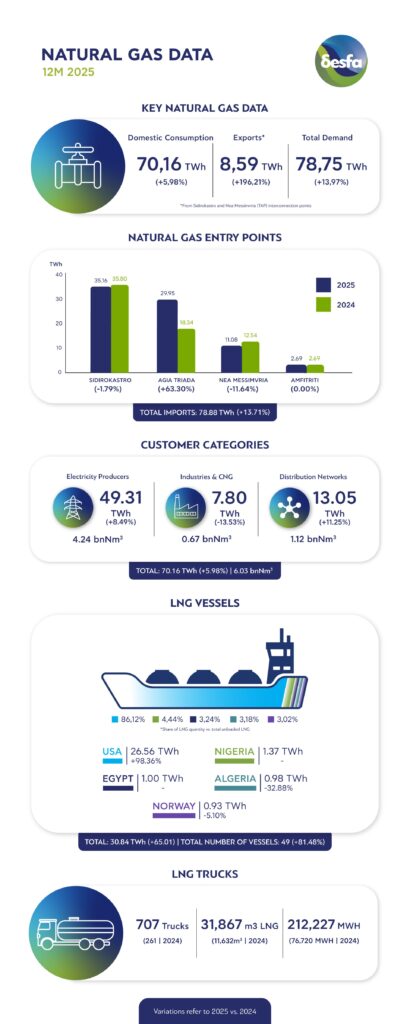



- Total natural gas demand in Greece reached 78.75 TWh in 2025, marking a 14% increase compared to 2024.
- Domestic natural gas consumption amounted to 70.16 TWh, showing a 6% rise year-on-year.
- Sidirokastro remained the main natural gas entry point, covering approximately 44,6% of total imports, while Revithoussa accounted for 38%, importing 63.3% higher volumes compared to the previous year.
- Tripling of natural gas exports (+196%) compared to 2024, reaching 8.59 TWh, strengthening the country’s transit role.
- Dynamic growth of the LNG Truck Loading service, with 707 LNG truck loadings transporting 212.23 GWh of equivalent energy in 2025, more than double the levels recorded in 2024.
Domestic natural gas consumption in Greece increased by 6% compared to 2024, reaching 70.16 TWh from 66.20 TWh in 2024, according to DESFA’s 2025 data, demonstrating that the Greek natural gas market continued its upward trajectory over the past year. This development confirms the stable position of natural gas as a key pillar of the country’s energy system.
Total natural gas demand, including exports, amounted to 78.75 TWh, up from 69.10 TWh in the previous year, recording a 14% increase compared to 2024. Natural gas exports tripled compared to 2024, rising by 196.21% to 8.59 TWh from 2.90 TWh the previous year, strengthening the country’s transit role in the wider region.
Natural gas imports in 2025 amounted to 78.88 TWh, recording an increase of 13.71% compared to 69.37 TWh in 2024. The largest volumes were imported into the National Natural Gas System through the Sidirokastro Entry Point, which accounted for 44.6% of total imports (35.16 TWh). This was followed by the Revithoussa LNG Terminal, through which 29.95 TWh were imported, corresponding to 38.0% of total imports, marking an increase of 63.3% compared to the previous year, despite the fact that the Revithoussa terminal remained out of operation due to scheduled maintenance during the period 22 May–11 June 2025. Via the Nea Mesimvria Entry Point, where natural gas is delivered through the TAP pipeline, 11.08 TWh were imported, covering 14.1% of total imports, while 2.69 TWh were imported through the Amfitriti Entry Point (Alexandroupolis FSRU), corresponding to 3.4% of total imports.
Regarding LNG unloadings carried out at the Revithoussa LNG Terminal during 2025, these amounted to 30.84 TWh, delivered by 49 LNG carriers, compared to 27 vessels in the previous year. The United States remained the country’s largest LNG supplier, with volumes of 26.56 TWh, representing an increase of 98.36% compared to 2024 and accounting for 86.12% of total LNG unloadings. This was followed by Nigeria with 1.37 TWh (4.44%), Egypt with 1.00 TWh (3.24%), Algeria with 0.98 TWh (3.18%), and Norway with 0.93 TWh (3.02%).
The development of the LNG Truck Loading service in 2025 was dynamic, confirming the growing market uptake of small-scale LNG solutions. Specifically, during the year, 707 LNG trucks were loaded, representing an increase of 171% compared to 261 LNG trucks in 2024. The total volume handled amounted to 31,867 m³ of LNG, or 212,227 MWh of equivalent energy, recording an increase of over 174% compared to 2024. The increased use of the service reflects the demand for flexible LNG supply solutions for industrial consumers, off-grid areas, and markets.
Finally, with regard to natural gas consumer categories, the largest share of domestic consumption in 2025 came from electricity generation units, which accounted for 70.28% of total domestic demand, recording an increase of 8.49% compared to 2024. Consumption through distribution networks amounted to 13.05 TWh, reflecting an 11.25% year-on-year increase. By contrast, consumption by industrial users and CNG stations declined by 13.53% compared to 2024.
In summary, 2025 was a year of dynamic activity, marked by a significant increase in exports, confirming Greece’s strengthened transit role in the wider region. At the same time, the increased utilization of the Revithoussa LNG Terminal and the impressive development of the LNG Truck Loading service, with triple-digit growth rates, highlighted the importance of DESFA’s infrastructure for the flexibility of the energy system and for meeting needs both within and outside the National Gas Transmission System, in an environment of increased energy demand, while simultaneously strengthening the diversification of supply sources and Greece’s role as an energy hub in the wider region.